The Tree of Life: An approach to working with vulnerable children, young people and adults
How can people be invited to speak about their lives in ways that make them stronger?
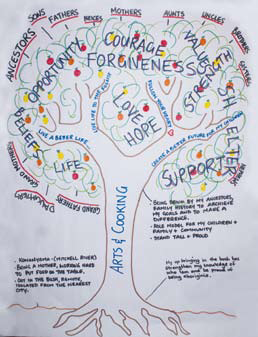
Table of Contents
Written resources
This original (2006) paper by Ncazelo Ncube-Mlilo describes the use of narrative ideas in work with vulnerable children in Southern Africa. How can the lives of children who have experienced significant losses be responded to in ways that are not re-traumatising and that bring to light children’s own skills and knowledge? What sorts of exercises can be used in camps for vulnerable children? How can children be provided with significant experiences that do not separate them from their families, values and cultural norms?
Tracing the roots of the Tree of Life narrative approach by David Denborough
As practitioners continue to invent further folk cultural narrative methodologies, it seems relevant to examine the particular local circumstances in which they were first created. This chapter (Chapter 3 in the book Do you want to hear a story? Adventures in collective narrative practice by David Denborough) traces the histories of the Tree of Life narrative approach, and makes visible some of the thinking that informed its development. It’s hoped that this will further a determination to continually unearth and create ways of working that are resonant and relevant to particular contexts, thus contributing to an ever-diversifying field of narrative practice, rather than simply replicating any of these methodologies across contexts.
Tree of Life facilitators’ guide
This workshop guide for the Tree of Life was created as part of the PSYCHOSOCIAL WELLBEING SERIES by REPSSI and Catholic Relief Services.
Tree of Life: a collective narrative approach to working with vulnerable children
This chapter (Chapter 4 of Collective narrative practice: Responding to individuals, groups and communities by David Denborough) includes excerpts from Ncazelo Ncube-Mlilo’s original paper, additional concepts (intergenerational acknowledgements; environmental education; considerations of child protection) and stories of practice from Palestine and Russia.
The Child and Family Refugee Service at the Tavistock Centre in London have run a series of ‘Tree of Life’ groups for both parents and children in schools. The groups were developed in response to a concern about the majority of psychological treatments which focus predominantly on vulnerability factors in refugee populations, and the effect that this can have on those they are attempting to help. Also, that these are modelled on western assumptions which do not adequately take account of culture. The Tree of Life groups have provided an alternative to traditional mental health services, which many refugee families find hard to access because of perceived stigma and lack of knowledge about what is on offer. The groups employed a strengths based narrative methodology, using the tree as a creative metaphor, which enabled parents and children to develop empowering stories about their lives which were rooted in their cultural and social histories. From this secure base, participants were able to develop shared, culturally congruent solutions to their problems. The groups have been found to benefit parents and children alike, as well as the school communities in which they have taken place.
Videos
Ncazelo Ncube-Mlilo teaching the Tree of Life
First Nations applications of the Tree of Life
Tree of Life in Aboriginal and Torres Strait Islander communities with Che Stow
Examples of Aboriginal and Torres Strait Islander Trees of Life
Using the Tree of Life to help young mums with Carolynanha Johnson
Adaptations
Ngarda ngarli nggu marri: Solid families: Strong in heart and spirit
Moorditj moort
by Anne Mead & Jasmine Mack
This resource was developed in response to the question ‘Is there a “parenting program” based on Aboriginal values and world view?’ As none were found, this program was developed. Many ‘parenting programs’ used in Australia are built on white people’s thinking about how to be parents. We hope this program enables people from Aboriginal and other cultural backgrounds to build on what they know and value about families and children.
Creating preferred family trees: Adjusting the recipe of collective narrative practices by Jennifer Swan
A tree of life song from India
This Tree of Life was created during a Tree of Life workshop in Vadapalani, India, facilitated by Sathesh Kumar, Mashreeb Aryal, and Louise Carmichael. For more information see the publication Listening for alternative stories: Narrative practices with vulnerable children and young people in India.
Training opportunities
For training in the Tree of Life narrative approach, contact:
- Ncazelo Ncube-Mlilo
Ncazelo offers online tree of life workshops through her organisation PHOLA. You can contact Ncalezo c/o [email protected].
- Dulwich Centre
The Tree of Life is included in Dulwich Centre’s one week Level One Intensives . It is also possible to arrange one or two day workshops for groups/communities and organisations. For enquiries about external training opportunities for the Tree of Life, write to us.
See the Tree of Life being used in different countries!
The interactive map below contains stories and accounts from workers and communities around the world who are using the Tree of Life to respond to various forms of trauma and hardship. A full list of countries is accessible in the sidebar.

Tree of Life