About Dulwich Centre
Dulwich Centre is an independent centre in Adelaide, Australia involved in narrative approaches to therapy and community work, training, publishing, supporting practitioners in different parts of the world, and co-hosting international conferences.
So much has happened since Dulwich Centre first opened her doors in 1983! First, a way of working, 'narrative approaches to counselling and community work' has evolved, particularly inspired by the work of Michael White and David Epston. This way of working has now moved from being a marginal approach to one that is now considered a mainstream modality in many contexts.
Second, a 'community of ideas' and a 'community of practitioners' has grown in different parts of the world. This community is linked in many ways – through ideas and practices, through the written word (journals and books), through Narrative Connections and other websites and e-lists, and through workshops and conferences. So many people have contributed to these developments in different ways.
Dulwich Centre has always been, and continues to be, a place of innovation and creativity. Throughout the time that Michael White was a director at Dulwich Centre (from 1983 until his death in 2008), he was continually developing new ideas to challenge and inspire the field and to invite us to think beyond what we already knew. Collective projects such as the Dulwich Centre alternative community mental health project and various narrative community gatherings also pushed the field in new directions. This process of innovation and extending what is known as narrative practice continues to be a key priority of Dulwich Centre (see Current projects).
Narrative therapy sessions are available at Dulwich Centre with Carolyn Markey, Chris Dolman, and Lisa Johnson.
Dulwich Centre Publications produce resources (including books, journals, and DVDs) with a particular focus on making narrative approaches accessible and relevant to a wide range of practitioners and contexts. Dulwich Centre Publications (DCP) is an independent, feminist-owned publishing house founded by Cheryl White in 1984. We deliberately seek to publish writings that represent a diversity of cultures and sexual and gender orientations, and which stretch and challenge dominant cultural understandings of the worlds in which we live and work. DCP has also been involved in publishing responses to current social issues occurring in Australia and elsewhere.
The Michael White Archive is located at Dulwich Centre. Michael White was one of the co-founders and co-directors of Dulwich Centre and worked here from the day we opened in 1983 until his death in 2008. The Michael White Archive includes Michael’s unpublished papers, video recordings of his teachings, and selected therapy sessions. In coming years, we will be making this material available to practitioners, students, and scholars.
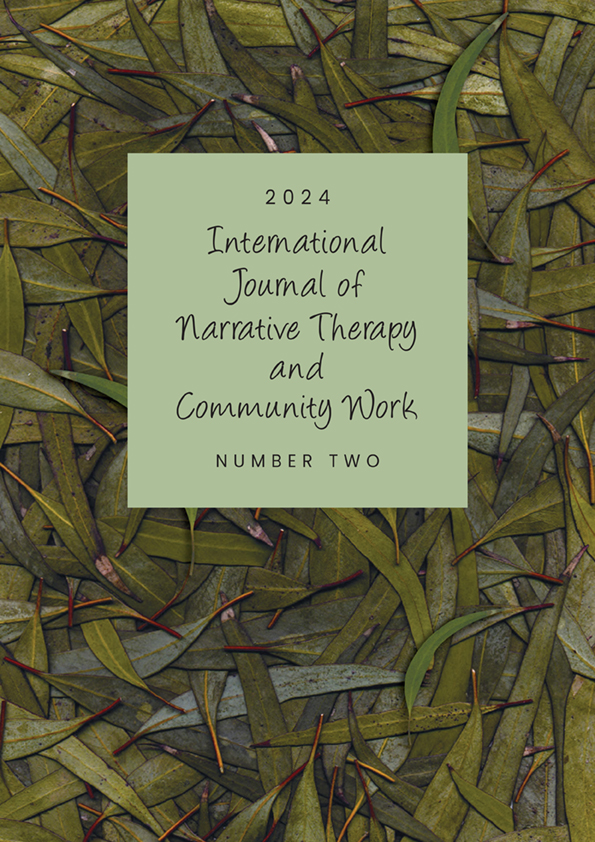
The International Journal of Narrative Therapy and Community Work is a peer-reviewed journal produced by Dulwich Centre Publications in conjunction with colleagues in different parts of the world. The International Advisory Group consists of members from Mexico, Hong Kong, Australia, New Zealand, South Africa, Norway, Ireland, Denmark, Austria, Israel, UK, and USA.
The Dulwich Centre Foundation supports workers and communities in different parts of the world who are responding to significant trauma. We are developing, putting into practice, and teaching collective narrative practices – ways of responding to individuals, groups, and communities who are experiencing hardship. These include the very popular Tree of Life and Team of Life narrative approaches. Recent work has taken place in Rwanda, Uganda, Bosnia, Haiti, and the Palestinian Territories. We are also exploring ways in which narrative practices can contribute to local social action and economic ‘development’.
At the same time, this Dulwich Centre website and the Narrative Therapy Library and Bookshop act as gateways to narrative practice. Narrative Connections: An international network of narrative practitioners seeks to provide a forum of connectedness for practitioners in different parts of the world.
Since 1999, Dulwich Centre has hosted International Narrative Therapy and Community Work Conferences in Adelaide (Australia), Atlanta (USA), Liverpool (UK), Oaxaca (Mexico), Hong Kong (China), and Kristiansand (Norway). The next conference is to be held in Brazil in 2011.
Dulwich Centre also offers an International Training Program: Narrative approaches to therapy and community work. This is the most rigorous, practice-based training program in narrative practice. The next program will begin in 2011. The faculty for this program includes Jill Freedman, David Epston, Lorraine Hedtke, Carolyn Markey, John Winslade, Sekneh Beckett, David Denborough, David Newman, Cheryl White, Jane Hutton, Sue Mitchell, Angel Yuen, and Chris Dolman.
As a small, independent centre we rely on your support for our continuing existence. We appreciate your support, ideas, and contributions!
![]() |
Cheryl White is the Director of Dulwich Centre and the founder of Dulwich Centre Publications where she works as publisher, editor, teacher, training co-ordinator, conference host, and initiator of projects. Cheryl is the co-editor of various books, including Conversations about gender, culture, violence & narrative practice: Stories of hope and complexity from women of many cultures. More information about the work of Dulwich Centre Publications can be found in the book A community of ideas: Behind the scenes. Cheryl is particularly interested in finding ways to support the work of practitioners in difficult and challenging contexts. She is the Chairperson of the Dulwich Centre Foundation which is vitally interested in the interface between narrative therapy and work with wider groups and communities. | |
![]() |
Barbara Wingard has been involved with Dulwich Centre since 1994 when she played a key role in the 'Reclaiming our stories, reclaiming our lives' gathering for Aboriginal families who had lost a family member due to deaths in custody. Barbara was one of the first group of Aboriginal Health Workers trained in South Australia. She is the co-author, with Jane Lester, of the influential book Telling our stories in ways that make us stronger. Barbara is one of the teaching team of the Dulwich Centre Foundation. She also plays a key role in Dulwich Centre's engagement in community projects. Barbara was named Elder of the Year (Female) in South Australia in 2008 and she is a current Commissioner for the Environmental Resources and Development Court. | |
![]() |
David Denborough (PhD) works as a teacher and writer/editor for Dulwich Centre Publications and a community practitioner for the Dulwich Centre Foundation. Recent books/publications include:
Recent teaching/community assignments have included Bosnia, Rwanda, Uganda, Canada, Brazil, Argentina, Chile, South Africa and a number of Aboriginal Australian communities. David’s songs in response to current social issues have received airplay throughout Australia and Canada. | |
![]() |
Carolyn Markey has considerable experience and great interest in counselling children, young people, and their families or caregivers in relation to a broad range of problems that are affecting their lives. Carolyn has particular experience in the areas of family separation, effects of violence and abuse, school-related difficulties, and working with people affected by concerns about anxiety or depression. Carolyn also enjoys using narrative ideas in group settings; this has included groups about sole parenting, living with the effects of violence and abuse, or groups of men wanting to take responsibility for abusive actions. Carolyn also has considerable experience supervising other practitioners in narrative therapy. Alongside her counselling practice, Carolyn works with the Teaching Partnership at Dulwich Centre and has taught narrative therapy workshops in Adelaide, throughout Australia, and in Hong Kong. | |
![]() |
Chris Dolman values and enjoys working with individuals, couples, children, and families who are responding to a broad range of problems and concerns in their lives and relationships. Chris works both in private practice and for a non-government organisation. In addition to having considerable experience in working with people facing issues of violence and abuse, he has worked with people around family separation, parenting, grief, addictions, mental health concerns, and relationship matters. | |
![]() |
Jane Hales started work in reception at Dulwich Centre on 30 April 1984, and has very much enjoyed her time here being involved with the office work, typesetting and layout of the journals and books, general accounting, workshop and conference organising including travelling to Atlanta and Liverpool for the conferences, database management, managing bookstalls, and more! Currently Jane is working as an assistant to Cheryl White. | |
![]() |
Lisa Johnson has a great interest in working with children, young people, and adults who are responding to a range of dilemmas and concerns. Lisa also offers professional supervision. Much of Lisa’s work has had her supporting people in relation to mental health concerns, experiences of trauma and violence, struggles with eating, and supporting families affected by disabilities. Lisa is particularly interested in how counselling conversations can link what people know about getting through tough times in their own lives with the hopes or dilemmas of others in similar situations. In addition to working at Dulwich Centre, she also enjoys working as a psychologist in a school community. |
|
The Dulwich Centre International Faculty includes: | ||
![]() |
David Epston, (MA, CQSW, D.Litt) is the co-director of The Family Therapy Centre and teaches at the School of Community Development, Unitec Institute of Technology. He is the co-author of Biting the hand that starves you: Inspiring resistance to anorexia/bulimia (2004), Playful approaches to serious problems (1997), Narrative means to therapeutic ends (1990), and many other publications. In 2002, he was recognized by a Special Award for Distinguished Contributions to Family Therapy by the ANZJFT, and in 2007, the American Family Therapy Academy presented him with the 'Distinguished Contribution to Family Therapy Theory and Practice' award. | |
![]() |
Jill Freedman is director of Evanston Family Therapy Center in North America, where she has a therapy and consulting practice. Together with her partner, Gene Combs, she has authored three books – Symbol, story, and ceremony: Using metaphor in individual and family therapy; Narrative therapy: The social construction of preferred realities, and Narrative therapy with couples.... and a whole lot more! – and more than 25 book chapters and articles. She teaches internationally and is very excited to be able to join in some of Dulwich Centre's programs. | |
![]() |
Angel Yuen is a school social worker and private practitioner in the multicultural context of Toronto, Canada. She has a particular interest in finding and co-discovering hopeful and creative ways of responding to hardship. She is also a founding member and faculty of the Narrative Therapy Centre of Toronto. In 2006 Angel joined the Dulwich Centre team to become a faculty member for their international courses. She is coeditor with Cheryl White of the 2007 book Conversations about gender, culture, violence and narrative practice: Stories of hope and complexity from women of many cultures. | |
![]() |
Lorraine Hedtke MSW, LCSW, PhD, is a professor at California State University San Bernardino, where she teaches school counselling and coordinates the program in Counselling and Guidance. Lorraine’s career has blended clinical practice and educational endeavor. She writes, researches, and teaches about social constructionist practices in conversations with the dying and the bereaved. She regularly teaches about death, dying, and bereavement and narrative therapy throughout the United States and internationally. She is an associate member of the Taos Institute in the US. Her articles have appeared in numerous professional and trade publications and newspapers. Along with John Winslade, she is the co-author of Re-membering lives: Conversations with the dying and the bereaved. Her children's book, My grandmother is always with me, is co-authored with her daughter, Addison. Further information and articles can be found at www.rememberingpractices.com | |
![]() |
John Winslade is a Professor at California State University San Bernardino and also teaches part-time at the University of Waikato in New Zealand. He has co-authored six books on narrative practice and is the founding managing editor of Explorations: An E-Journal of Narrative Practice. | |
![]() |
Ruth Pluznick is the clinical director a public children's mental health centre in Toronto and a senior faculty of Narrative Therapy Centre. For the past three years, Ruth and her colleague, Natasha Kis-Sines have participated in the 'gathering stories ' project initiated by Dulwich Centre, developing narrative ideas and practices where a parent is experiencing mental health difficulties. Ruth's agency, Oolagen Community Services, is also involved in a partnership with Dulwich Centre in an initiative designed to foster intergenerational alliances within the Tamil and other multicultural communities in Toronto and the Kite of Life exercise. | |
![]() |
Jane Hutton is a social worker and narrative therapist with over 20 years of experience. She enjoys meeting with both children and adults to collaborate on resolving a wide range of difficulties. She offers narrative supervision and training to many different individuals and organisations. Current passions (other than soccer) include creating resources like the Lost in normality kit to facilitate the understanding of narrative therapy ideas and what they can offer, and working with like-minded colleagues at rooms based in the Sunshine Coast Hinterland town of Palmwoods. Jane is able to teach about narrative therapy in English and French. | |
![]() |
Sekneh Beckett lives in Sydney, where she is part of the teaching team at Macquarie University’s Social Health course. Sekneh enjoys working with people from diverse backgrounds and holds a position of curiosity from which to explore and honour people’s creative acts of resistance. Sekneh is able to teach about narrative therapy in English and Arabic. | |
![]() |
Jodi Aman lives and works in New York. She is the founder of the Center for Narrative Practice, an independent family therapy, community work, and narrative practice training facility. She meets with people of all ages about a variety of predicaments in their lives. Jodi has many special interests: working with couples, young children experiencing anxiety or sadness after a loss or trauma, families in transition of separation or re- partnering, and meeting with refugees and war veterans and their families. She joined the Dulwich Centre Teaching Faculty in 2007. | |
![]() |
David Newman lives and works in Sydney where he has an independent counselling practice through Charing Cross Narrative Therapy Centre. David's recent teaching assignments have included China, Rwanda, and Palestine. He is currently working with Marnie Sather in developing resources for families who have lost loved ones to suicide. He is the author of the influential paper 'Rescuing the said from the saying of it: Living documentation in narrative therapy'. David can be contacted c/o Charing Cross Narrative Therapy Centre: Email:
This e-mail address is being protected from spambots. You need JavaScript enabled to view it
| |
![]() |
Ncazelo Ncube-Mlilo is an educational psychologist and a narrative therapist with over ten years experience working with children and communities affected by and infected with HIV and AIDS in east and southern Africa. She currently works as an independent consultant/service provider providing services that include training and capacity development on child-centred, family, and community-focused approaches/ methodologies to help alleviate trauma and hardship. Ncazelo works with different organisations and government departments throughout Africa. In 2008, Ncazelo formed the Family Strengthening Center of Southern Africa which helps families cope with hardships in the context of HIV and AIDS, poverty, and conflict. | |
![]() |
Tileah Drahm-Butler is a Durumbal woman who lives in Kuranda, Far North Queensland. A social worker with the FNQ Rural Division of General Practice, Tileah works on a Closing the Gap Program that aims to improve mainstream health services to increase Indigenous access. Tileah developed and delivered the Drop the Rock Program which trained Aboriginal people from Cape York in mental health work and social and emotional wellbeing. She enjoys training and group work and using narrative approaches in group work and community practice. | |
![]() |
Radhika Santhanam-Martin is a clinical psychologist who works in the field of trauma. She has more than two decades of experience in clinical practice in institutions in India, Canada and Australia. In Australia, she has worked in tertiary hospitals and universities as a clinical consultant and senior lecturer. Over the last ten years, the focus of her work has been on mental health service development and evaluation in Indigenous contexts. Currently she works with refugees, asylum seekers and immigrant families in group, family and individual settings. Her primary interest areas include: a) ways of working with cultures b) attachment and trauma c) narrative methods of practice and d) enhancing the reflective capacity of workers in health in settings using professional supervision. Radhika is assisting Dulwich Centre Foundation in relation to a number of projects. | |
Archive / history |
||
![]() |
Christian Beels is a retired psychiatrist who has specialized in work with the families of the severely mentally ill, helping to form institutions and narratives that make use of their numbers and their common experience. At Bronx Psychiatric Center, he founded an inpatient and outpatient service that served the mentally ill of a large area of the Bronx with multi-family groups as the centerpiece of their psychiatric services. At the Psychiatric Institute affiliated with the Columbia Psychiatry Department, he founded the Public Psychiatry Fellowship, a program that introduces psychiatrists after residency to the possibilities of a career in the public sector. He is the author of A different story: The rise of narrative in psychotherapy. | |
Consultants | ||
| We involve a wide range of consultants in all the different projects we are engaged with. The following people, however, are longstanding consultants whom we turn to time and again for advice, feedback, and reflections. | ||
|
![]() |
|
|
Barbara Wingard
(Australia) |
Angel Yuen (Canada) |
Charles Waldegrave (NZ) |
![]() |
![]() |
|
| Taimalieutu Kiwi Tamasese (Samoa/NZ) |
Tim Agius (Australia) |
Mary Pekin, Mim Weber, Manja Visschedijk (Australia) |